
- 03-07-2018 07:16
- Velizar Petrov
Thematic meeting and transnational walkshop in Harghita
County, Romania
In the eastern part of
Transylvania, Harghita County lies in a depression surrounded by the Eastern
Carpathians. Due to its geographical position, Harghita County offers a variety
of landscapes and natural wonders, thus making it great for the tourists who
are looking for healthy and green destinations. Odorheiu Secuiesc/Székelyudvarhely,
a city in Odorheiu region rich with hills covered with leafy vegetation and
warmer climate was the location of the INSiGHTS project partners meeting held
from June 18–21, 2018 by Harghita County Council. The focus of the visit was on
the transnational learning and exchange on green, healthy tourism, destination
management and product development. Partners were introduced to the best
practices of Harghita County, starting with a taiga reservation, a butterfly
house and a salt mine, followed by the Legendárium studios, the Szekler gates
and a cheese manufacture.
Partners met on Monday afternoon at
the 4-star Septimia Resort-Hotel in
Odorheiu Secuiesc/ Székelyudvarhely
and were welcomed by Botond
Barna Bíró, the vice-president of Harghita County Council
and by Lóránt Verzár, the director of Septimia Resort-Hotel. The welcome
speech was followed by Dr. Zoltán István Miklós, the director of the Haáz Rezső Museum of Odorheiu Secuiesc,
who gave a short presentation of Harghita County, followed by a Master Class on
Tourism destination management schemes and product development presented by Michael Meyer from CEEweb. Parts of the
Master Class were also three professional presentations on Szekler product
development presented by István Márton from Rural Development Association of Harghita County
Council; Via Mariae pilgrimage route presented by Károly Szabó from
Harghita Community Development Association and Mountain tourism presented by Örs Fekete form Mountain Rescue Service
of Harghita County Council.
Tuesday morning started with the steering committee meeting and the thematic meeting in the Septimia
Resort-Hotel. There were project management issues and communication activities
presented along with the methodological guide for national tourism policy
assessment.
The morning meetings were followed
by a traditional Szekler lunch, held at the Gizi restaurant its interior was decorated with handcrafted products
making the place very cosy. After lunch, partners travelled to Fântâna Brazilor/Fenyőkút where they took a tour of the peat bog. Partners
discovered a unique habitat, some special phenomena and rare relict species
through the taiga educational trail. The next stop of the study visit was
Praid/Parajd, where partners visited the butterfly
house which offers moments of relaxation and excitement to both children
and adults. It is the first permanent butterfly house in
Romania. Built for this purpose and opened in 2012 it houses up to 9
different common species and several hundred specimens of butterflies. Since
the life span of a butterfly is only a few weeks, the species are always
changing, thus offering visitors a chance to experience something different all
the time. The study visit was concluded
with a visit of the Salt mine in
Praid/Parajd. Having estimated reserves of 50 billion tonnes of NaCl it
represents the largest salt reserve in Romania. The underground visiting space
is 120 m below the surface and offers visitors the saline air beneficial to the
respiratory system. With many sports facilities, playground for children and a
chapel it offers many of the comforts of the life above ground.
On Wednesday partners travelled to
the Legendárium headquarters in Odorheiu Secuiesc/Székelyudvarhely were the production of
the animated series on the mysteries of Transylvanian legends takes place.
Partners were familiarized with the animation process and watched one of the
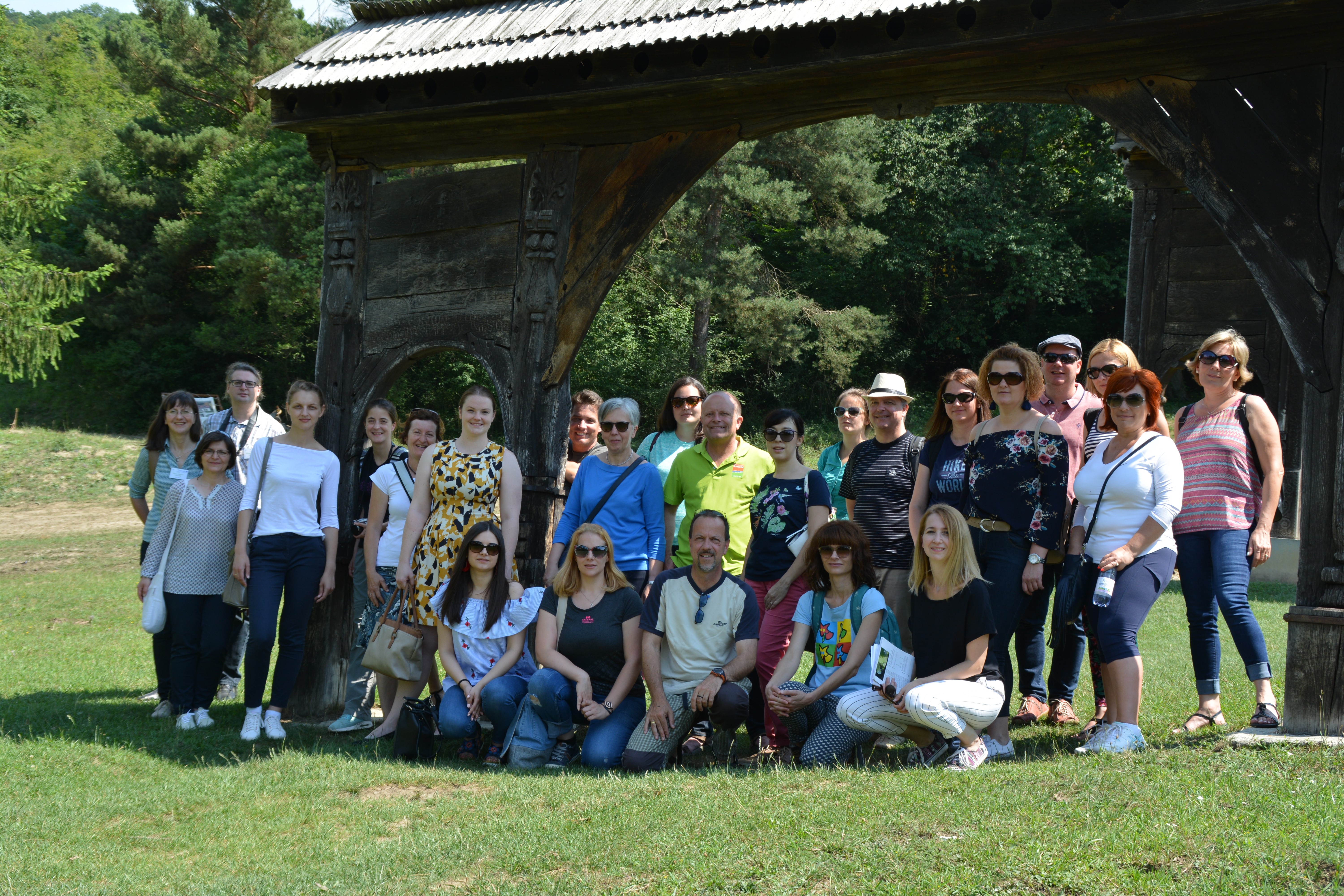
cartoons. This was followed by a visit of Băile Szejke/Szejkefürdő where a huge park dedicated to Szekler folklore is under construction. Partners
took a walk uphill along the permanent exhibition of the traditional Szekler
gates to the Orbán Balázs memorial.
After that, partners travelled to Merești/Homoródalmás and visited a cheese manufacture. The family who runs the manufacture is a third
generation of cheese makers. They have transformed a traditional barn so they
can produce cheese on the ground floor and live upstairs. The presentation of
the manufacture was followed by cheese tasting.
After lunch partners met again for a
critical classroom in which
discussion about integrated management schemes was held. In the evening partners
gathered one last time for dinner in order to officially conclude the meeting.
The next multilateral meeting will
take place in Komárno in November 2018.